-
Singularity, Singularities
We read Langdon Winner’s essay “Do Artifacts have Politics?” for class today. Winner argues that artifacts can have intentional or unintentional politics. He gives as example the nuclear power plant, which requires a central chain of command and coordination to function properly, which then necessitates a kind of hierarchical societal structure that enables that chain of command. He contrasts this with the social determinism which argues that the conditions of society creates technology.
It seems to me that both viewpoints are equally valid, and that one cannot ignore that after technologies have been created, we tend to not question them, and our laziness and inertia makes existing systems more and more entrenched. The bias of Kodak’s film color balance reflect this.
One of the ways to combat this might be to make sure that we think carefully about who is involved in the design of technologies. This is certainly not foolproof, but one of the ways in which we can make sure that as many voices in the room are represented.
-
Studying the Past
Zach’s concept for the class is to study one artist each week, and to try to bring them into the room. I found this profoundly moving, and the more I thought of it, the more it made sense, especially when dealing with computer art. Today we explored the works of Vera Molnar, a contemporary artist who made computer art. She was part of a group called the Algorists, who, according to Roman Verostko, are “artists who create art using algorithmic procedures”. Is the process of studying artists perhaps also an algorithm for producing art?
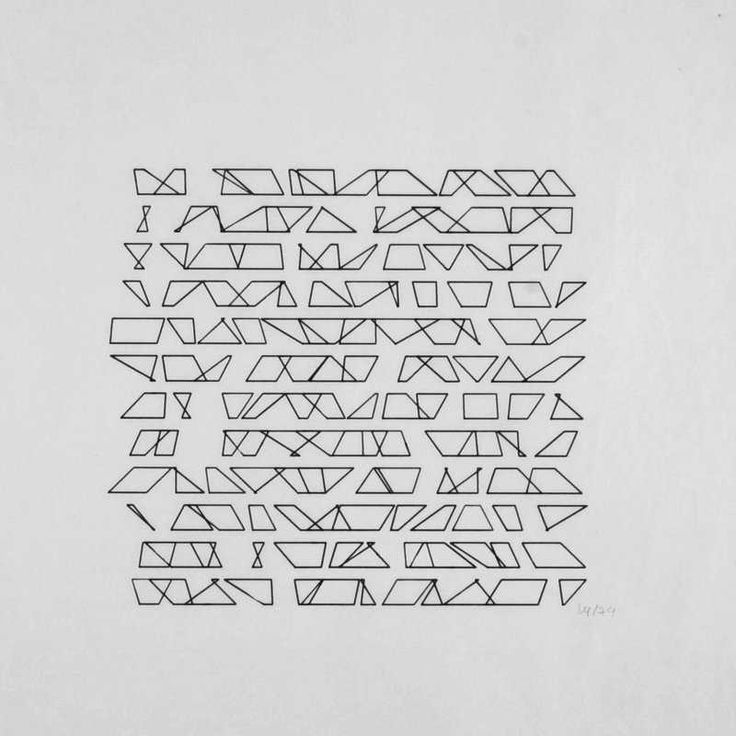
Taken very broadly, there is no computer art that is not algorithmically generated, for that is the language in which we talk to computers.
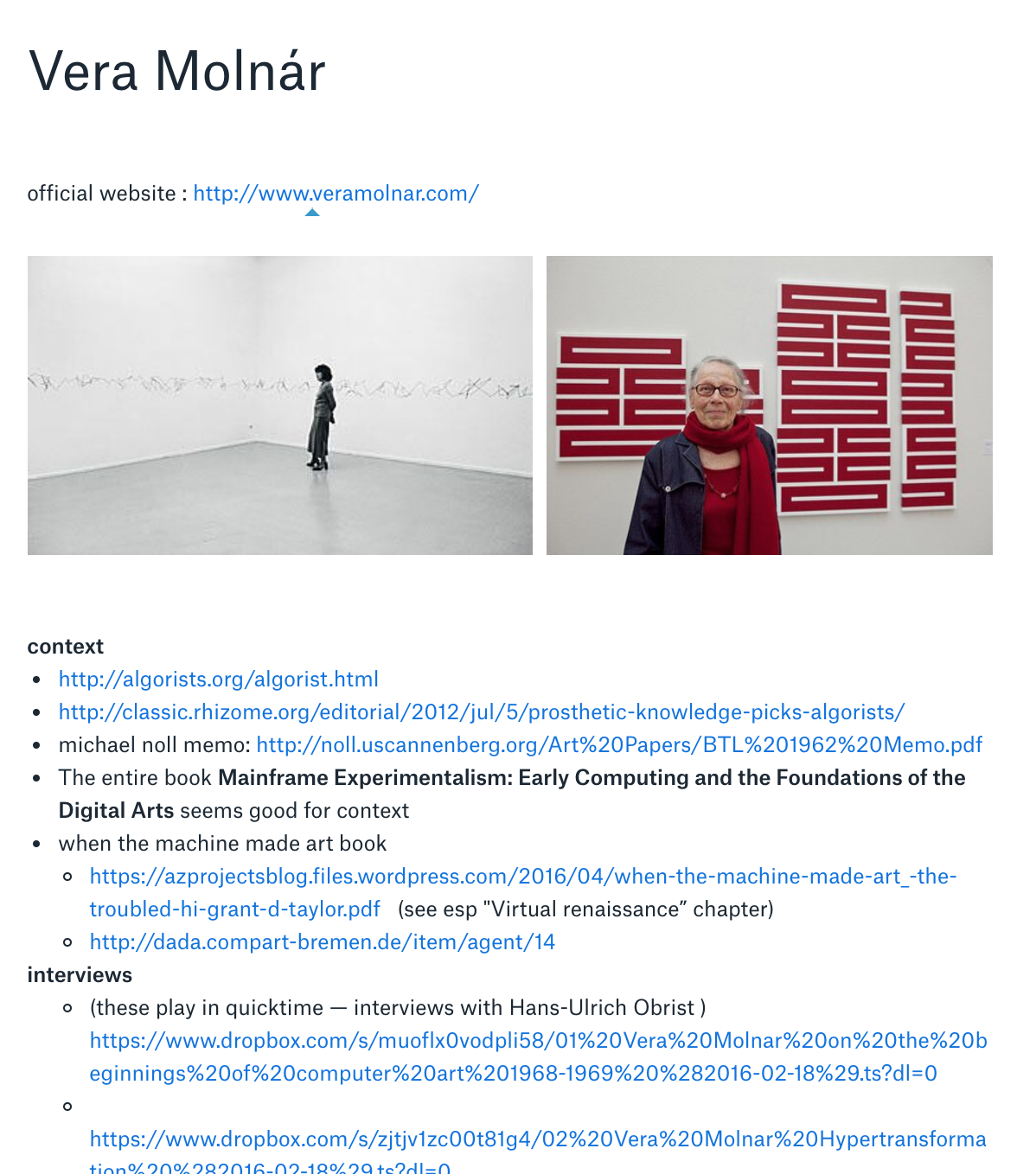
One of Zach’s amazing techniques for teaching(and generally a theme for SFPC) is getting all of us to contribute our knowledge to the work at hand, so we collaboratively sourced her writings, articles and interviews about her into a single document.
I was really moved by one of her works, called ‘My Mother’s Letters’, that I will cover in another blog post.
-
Critical Thinking Again
There’s a danger in relying too heavily on logic. The danger is in the determination of the starting point. Once a starting point is chosen, there are a limited number of logical conclusions to a problem. For example, imagine a store owner who believes that he must raise his revenues to increase his profits. He tries multiple methods including advertising, increasing inventory, and product bundling to make every possible sale to his customers. But he forgot that he could also reduce his costs to increase profits, and in doing so missed what could have been much less expensive, less demanding options.
I found this really beautiful quote on linear thinking in my research on critical thinking. In it, the author illuminates beautifully, the danger of rational thinking, which is that one might find a local minima to a solution.
What can the Las Vegas and Monte Carlo schools of thought teach us about thinking?
-
One easy step to thinking critically
What struck me about “All Watched by the Loving Grace of Machines” was that Curtis seemed to cast unending doubt our ability as human beings to model systems, be it man-made or natural. These same systems which attribute the rise of global temperature to human causes, or the systems that describe our bodies reaction to many toxins or stimuli. I agree that they are not perfect, but the unrelenting criticism is unwarranted.
We started our first critical thinking class with a brief discussion about critical thinking. According to this publication, critical thinking is a mode of thinking that:
- seeks to improves the quality of our thinking
- entails effective communication and problem solving abilities
- has a commitment to overcome our inherent biases
In addition to this, the wikipedia article on critical thinking had pointed out a ‘second wave’ of critical thinking proposed by Kerry Walters in 1991. She said that in addition to logical reasoning, critical thinking needs to encompass non-linear processes of thought, and that a purely logic based definition of critical thinking, logicism, is “the unwarranted assumption that good thinking is reducible to logical thinking”.
It seems to me that the end goal of critical thinking is to ensure that we do not hold a one-sided view of any particular view - to understand that no action has objectively good or bad value. In addition, one must not only remember this, but somehow also put it into action(commitment to overcome inherent biases). After all, it is pointless to be aware of one’s own racial bias(for example) yet continue to do anything about it. The question is where we draw the line. Do I stop using Google because of their monopolistic practices and aggresive data-collection? Do I stop using iPhones because Apple refuses to protect Chinese citizens from surveillance? I’m both pessimistic and optimistic about our human nature. I believe that we believe in long term ideals, but that we are unable to refuse the short-term gain(and long-term loss) as opposed to the short-term loss(and long-term gain).
This is why I believe that art should inspire action, but action so easy that the laziest of all people can take on. Perhaps this ties back to one of Taeyoon’s words, that learning is about a forming of habit. Critical thinking is a form of learning, which is a habit. And habits are hard.
-
First day!
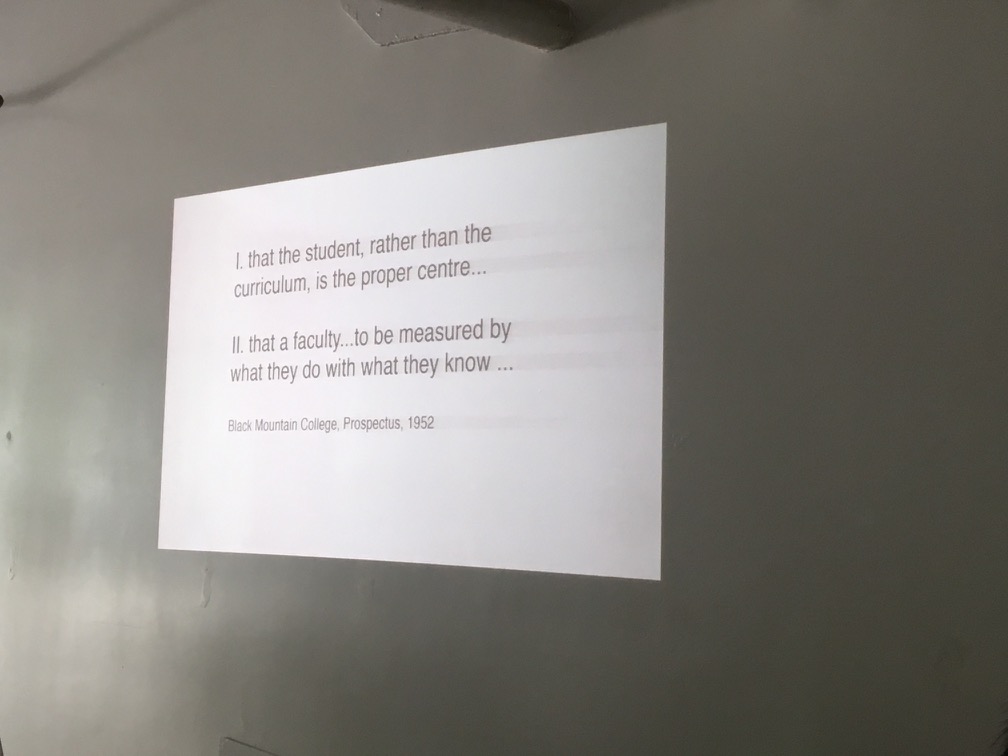
We started class today and Taeyoon introduced the philosophy of SFPC to us. It struck me that a great deal of responsibility is being handed to us to direct the program, and that we have to always remember that.
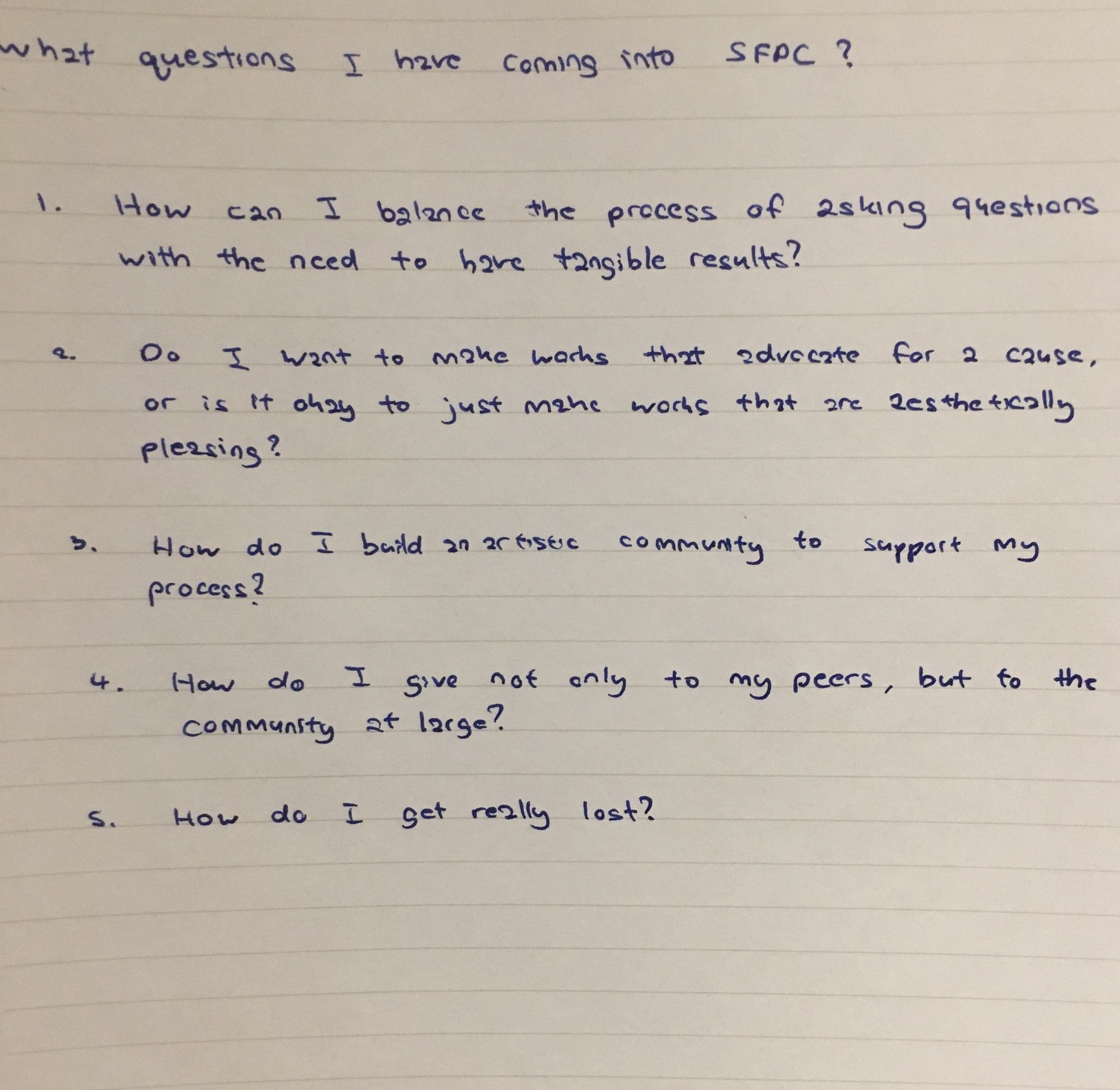
I think it’s also telling that the founders of SFPC started the course asking us to come up with a list of questions that we had for the class, as opposed to a list of goals, like how I did. I have to remind myself not to jump the gun and make too many assumptions in the effort to make speed.
subscribe via RSS